
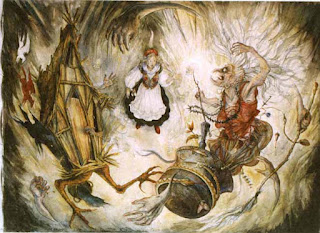
Leshy, woodsman, forest Leshakov, forester, Lesun, forest grandfather, Forest righteous dikonky peasant, puschevik, wolf shepherd sometimes even just a timber - a supernatural being of Slavic traditions and Russian fairy tales. Place of residence of the spirit - a deaf forest dwellers, but sometimes a wasteland. However, this spirit lives in the woods is not constant, but only in the warmer months. "At Yerofei" - considered the peasants, - "the forest goblins to part." On this day (October 17) the spirit falls to the ground, where the winters until spring, but before hibernation devil rages: raises a storm, breaking trees, dispersing animals in burrows and rampant. According to Polish legend devil loves to sit on the old dry trees in the form of an owl, so the farmers are afraid to cut those trees. Belief in the Russian devil loves to sit on the branches, and in the hollows of trees. At this point there is a saying: "From the empty hollows, or owl, or owl, or Satan himself." The procession is accompanied by a goblin by the wind, which sweeps up his tracks. Because of the love goblin of the wind, people, being in the woods, avoiding the whistle, so as not to bring this spirit.Goblin looks like an old man or a man with a white beard, dressed in the usual peasant dress, but some details of his otherworldly nature of stress: the right of sex clothes smell of it left, the left shoe is put on the right foot, and right to left, and when he sits down, always throws his left leg on the right. Sometimes the thought that the Goblin is never girded. Wear it in white, red, black or green

A characteristic feature of the Goblin - his ability to change its growth. It can be flush with the tops of trees or grass below. Leshy could turn into any animal and any bird in a tree, bush or fungus. In the tradition of the appearance of severnorusskoy Goblin is usually associated with a variety of weather events, especially the whirlwind or the sharp wind. Goblin is a habitat for the entire forest, but his favorite place - snags, fleshy rooted trees, forest hut.Goblin guards the woods and completely disposed of all that is there. Goblin guards and grazing herds of wild animals, is the head over all the wolves. He often overtakes from place to place herds of hares, wolves, squirrels, field mice and rats. In total more than he loves bear, and when he drinks wine, to which a great hunter, and it treats all means bear. The last goblin watches when he goes to bed drunk, and protects it from water attack. According to KD Loginovskaya collected in the Transbaikal region, "the service of the devil people require payment in the form of treats with vodka."Goblin, on request, surpasses the protein, foxes, hares, field mice from one forest to another. In the belief of Ukrainians, polisun, or woodsman, driving whip hungry wolves where they can find sustenance. According to popular stories of goblins love the card game, where the rate of whites are even rabbits. So the mass migration of these animals, a reasonable explanation for that hard to find, are actually paying gambling debts. According to the "tales of the North" NE Onchukova, food woodsman is "yes cleft Squirrel Beef" is also called wild apple "leshovkami", suggesting that the devil grows these apples for themselves.

The horse feels the goblin before the rider or driver, and may suddenly stop or fear to rush to the side. Goblin war with dogs, domesticated by man, but sometimes has his own dogs, small and colorful.Some goblins live alone, others - their families, and build a spacious house in the woods, where they hosted the wife and their children grow up. Real Estate goblin - timbered cottage in the thick spruce forest far from human settlements. In some places, believe that goblins live whole villages. Sometimes in the big woods to live two or three goblin, who sometimes quarrel among themselves for the division of forestry cottages (Arkhangelsk province). Brawl comes to shove, goblins beat each other century-old trees, which they uproot and stopudovo stones chipped from the rocks. Stones and tree trunks they quit at 50 miles or more. Frequent as the battle sprites with water, mostly in the night-time. In the Russian North noted the phrase "devil walked" that badly done.Others are kidnapped or lured leshii to my girls and women and live with them. Goblin children are abducted to the baptism of infants. It is believed that the Goblin's wife come from the shower ruined their girls, who were cursed by their parents. To get the people who led the goblin at the crossroads laid for him a treat: bacon, a pot of porridge, pancakes. Food wrapped in a clean cloth with a red thread, bowed to the four corners of the crossing and did not return a relative asked the Goblin.Also attributed to the devil with the abduction of children:But everywhere hung on the way, leprosy and evil goblin!Steal of the beast - not found in rat traps hung.And how many children he took to himself a portage Kaysky!Not to rain on the bitter tears soaked the whole region Prikamsky.Goblins entice children who live poorly in their family, a good attitude, so they called the goblin "good uncle".

Sometimes goblins take away their children with them, the latter become wild, cease to understand human speech and wearing clothes. Instead of stealing a baby, goblins sometimes placed in the cradle of a bundle of straw or a piece of wood, and sometimes leave their offspring, ugly, stupid and gourmand. Upon reaching 11 years of age, changeling escapes into the woods, and if it remains between people, it is a sorcerer.Devilry also like to sing, sometimes long and loudly (like a storm), accompanying himself clapping his hands.According to Polish legend devil loves to sit on the old dry trees in the form of an owl, and so farmers are afraid to cut those trees. Belief in the Russian devil also likes to hide in the hollows of trees. At this point there is a saying: "From the empty hollows, or owl, or owl, or Satan himself." The trees goblins spend most of the time, rock and "fooling around" for them - the most favorite pastime, why in some provinces, he was given the name "zybochnik" (from the cradle, the cradle). The procession is accompanied by a goblin by the wind, which sweeps up his tracks. This devil like wood elves Swedish folklore.As the Goblin was considered the master of all beasts and fowl, without a treaty with him the hunter could not hunt, or he was without extraction or died. In areas where cattle graze in the forest, the shepherd had to sign a contract with the devilry has the right to graze cattle on his land. To do this, the shepherd went into the forest at midnight and called Goblin. The fact that the contract should have been a shepherd to keep in strictest confidence, or goblin could kill him.
For breach of contract goblin punishes shepherd harm to himself or to livestock. The shepherd could beg forgiveness Goblin, standing in the woods on his knees and bringing the gift of bread and glasses of vodka or money. If the shepherd breaks a promise to give the devil with one cow from the herd, the Goblin kills him.If a person because of the jokes goblin gets lost from the forest, he falls into another world, and it can stay forever. To return home, it is necessary to turn everything in the world "upside down" to change the familiar notions that do not save, to agree to step on the way "other" world ... Then the devil takes you for her and let go. People are twisting clothes inside out, change one's shoes shoe with his left foot to the right, twisting the insole, turning his hat backwards, trying to read the prayer. But the goblins never hurt small children, by chance, or curse their parents found themselves in possession of the forest owner. Children are most often seen both worlds, so they are "closely related" and the people and spirits. Most likely, goblins, fooling and confusing signs, could lead a person from the real world into a parallel world or sopredele, where everything is almost the same as at home, but his native village may not exist, etc. Leprosy can be easily otchuratsya goblin, of course, above all, prayer and the cross, and then using known techniques which are taught from an early age, according to the precepts of the fathers and grandfathers.

Thus, the lost is recommended to sit on the first deck, take off, and equivalent to the inversion of the dress inside out and then in a form to put on. Always at the same time as the left shoe to wear on his right leg or right glove on his left hand.If you got into trouble two or three, they should all peremenyatsya clothing, pre-inversion it inside out (in this case it is recommended to emulate the custom of the same goblin who has everything upside down and inside out). You can just help out of trouble, talked to your favorite goblin saying that successful people have time to overhear him from afar: "It was found to have lost," or cry out: "Sheep muzzle, wool," - and immediately disappears from the goblin cry: "A guessed! "It is believed that what belongs to the devil with, surrounded by an invisible wall "closes", dragging in the "other" world, and only a sorcerer can see where the missing animals or things. To find the lost beast does not have to go looking to the intersection of forest roads, leaving it two eggs, and ask the first available person (who will be devilry) - where to find the lost item.Goblin walks in the woods the night before the first cock, and then sleeping in forest hut. Goblin in the summer celebrating the wedding, during which a storm in the forest. Sprites go in winter below ground in the day over. Yerofei (4/17.X) and re-emerge in spring when the snow begins to melt and the earth opens.In general, fearing the evil goblin and unexpected fancies, forest people would not mind a good laugh over it, and use his name as a dirty word all the baptized Rus said first pleasure ("Go to hell," "Goblin would run over you," etc.).The myth of the sprites without reason existed on Earth millennia. According to popular views, the devil is as if the unconscious weapon of punishment for voluntary and involuntary sins. For example, the devil in front of everybody took the guy for what he, climbing tower, indecent swear word. Even more devil punishes utterances of curses, and if it happens, for example, that the new mother, having lost in the throes of childbirth all patience, curse yourself and the child, the child is considered to be the property of their goblin - as soon as the last measurement of the sound uttered a curse.

Promised by the devil takes the child into the woods immediately after birth by putting in place a "forest child" - a sick and troubled. If by some miracle manage to christen the child's arch before, so that you can not take it immediately, then the devil is waiting for up to seven years of adolescence and then entices him into the woods (the devil with given one minute per day, when he enticed a person may be).In the forest damned short-lived and soon die. And if it happens that one of them, fervent prayer of a mother's will survive, they find it in the most miserable form, he goes wild, can not remember what happened to him, and keeps indifference to everything that it can be expected for living together with people.The village is very persistent rumor credited devilry has a passion for women, and often accuse them of kidnapping young girls. Ascribed to them, and women with the same breed (leshachiha, leshuha) and calves (leshenya).In ancient times shepherds in the early summer of devilry entered into a contract: milk from cows not suck, the cattle in the marshes did not drive, etc. If the contract is breached, the offender written complaint to the general board and suspended from the hollow tree in the thicket - let Santa Treefolk understand.

 Russia Dial Codes


 The horse feels the goblin before the rider or driver, and may suddenly stop or fear to rush to the side. Goblin war with dogs, domesticated by man, but sometimes has his own dogs, small and colorful.Some goblins live alone, others - their families, and build a spacious house in the woods, where they hosted the wife and their children grow up. Real Estate goblin - timbered cottage in the thick spruce forest far from human settlements. In some places, believe that goblins live whole villages. Sometimes in the big woods to live two or three goblin, who sometimes quarrel among themselves for the division of forestry cottages (Arkhangelsk province). Brawl comes to shove, goblins beat each other century-old trees, which they uproot and stopudovo stones chipped from the rocks. Stones and tree trunks they quit at 50 miles or more. Frequent as the battle sprites with water, mostly in the night-time. In the Russian North noted the phrase "devil walked" that badly done.Others are kidnapped or lured leshii to my girls and women and live with them. Goblin children are abducted to the baptism of infants. It is believed that the Goblin's wife come from the shower ruined their girls, who were cursed by their parents. To get the people who led the goblin at the crossroads laid for him a treat: bacon, a pot of porridge, pancakes. Food wrapped in a clean cloth with a red thread, bowed to the four corners of the crossing and did not return a relative asked the Goblin.Also attributed to the devil with the abduction of children:But everywhere hung on the way, leprosy and evil goblin!Steal of the beast - not found in rat traps hung.And how many children he took to himself a portage Kaysky!Not to rain on the bitter tears soaked the whole region Prikamsky.Goblins entice children who live poorly in their family, a good attitude, so they called the goblin "good uncle".




 Ulyanovsk Time
 Russian Ruble Exchange Rate


